

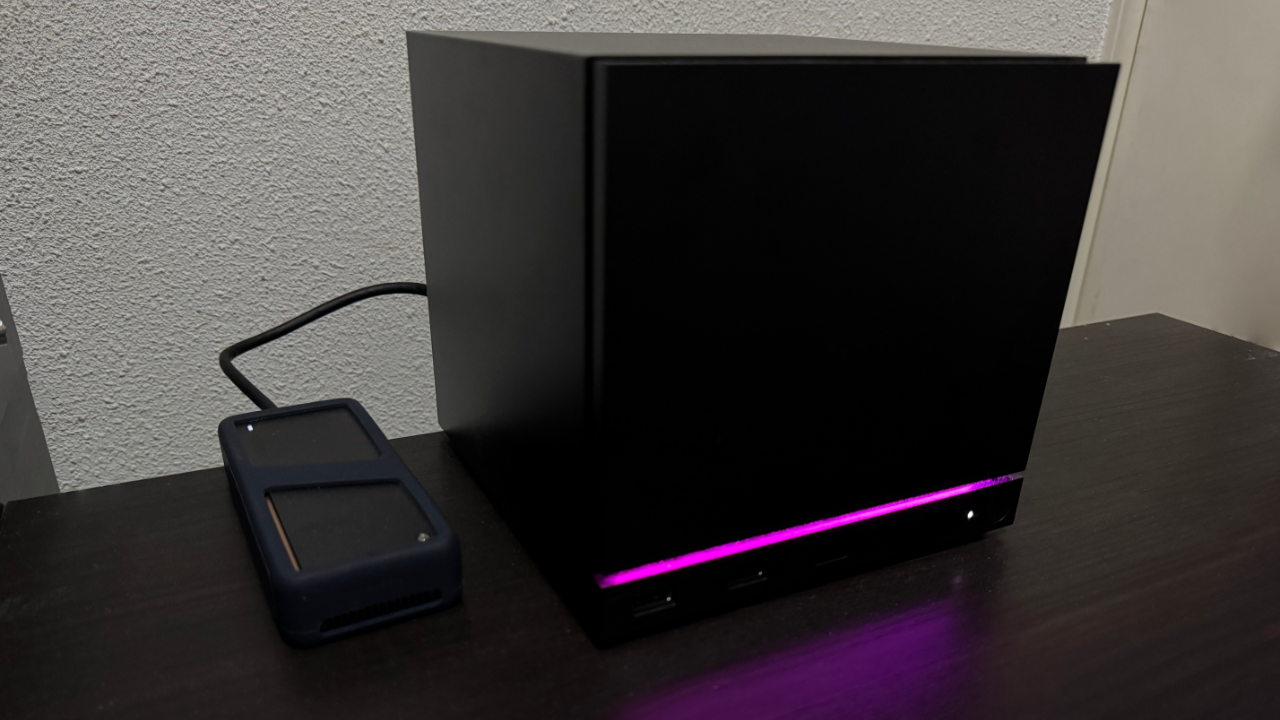
I paid €1360 for the 2 TB Steam Machine. That's a lot of money for a gaming PC, especially when I already have a desktop with a 13th-generation Intel Core i7 and an Nvidia RTX 4070.
But I was buying this machine for my bedroom, which changed what I wanted from it. It needed to run most of my games well without making a racket, look comfortable in the room, and arrive ready to use. I didn't want another PC-building project.
I've had it for about two weeks now. To explain how it's worked out, I need to start with that price, because the AI boom has become part of the calculation too.
An expensive machine with a known price
The AI boom makes me uneasy about the cost of building a PC. Memory and storage manufacturers have enormous demand coming from data centres, and consumer hardware buyers aren't necessarily their priority.
There's a concrete example of that. In December 2025, Micron announced it was leaving the Crucial consumer business, citing AI-driven demand for memory and storage and a decision to prioritise larger strategic customers. That's a direct connection between the AI build-out and a manufacturer moving away from a familiar consumer brand. Micron's announcement.
That doesn't tell me exactly what a particular RAM kit or SSD will cost next month. It does make me less confident that waiting another year will automatically get me a better deal. My worry is that, while this AI boom carries on, putting together a comparable machine could become more expensive.
Against that uncertainty, a complete Steam Machine at a fixed purchase price has an appeal of its own. I knew the configuration and the total: €1360 for the 2 TB model. I could decide whether that package was worth it to me without tracking several component prices or revising a parts list as stock and offers changed.
By fixed price, I mean the total I could buy it for at the time. I'm not assuming Valve will keep that price forever, or that a finished PC is immune to rising component costs. The useful part was being able to make one purchase and be done with it.
That certainty doesn't make €1360 cheap. It makes an expensive purchase easier to assess. I could judge a complete machine against what I wanted, rather than build my decision around hoped-for discounts or a prediction about when the AI bubble might burst.
Why I wanted a finished bedroom PC
Could I have built something comparable for the same money, or less? Maybe. I don't have a like-for-like cost comparison to offer. But matching the performance would only have been part of the job. I'd also have needed to choose a case and cooling setup that suited the bedroom, then put everything together. I didn't want to take that on this time.
Noise mattered because this is a room where I also want to relax. More performance wouldn't automatically make a computer a better fit if its fans became a constant distraction. Quiet operation was part of what I was willing to pay for.
So far, the Steam Machine has been quiet in my use. Its sleek design also suits the room. Appearance doesn't make a game run faster, but I think it's reasonable to care about how something looks when it's sitting in your bedroom every day.
I also have the good fortune to have some disposable income. That gave me room to put convenience and quiet operation ahead of getting the most performance out of every euro. It doesn't mean the same calculation will work for everyone. Of course, none of that would count for much if playing my games felt like a struggle. My desktop is still more powerful. The Steam Machine doesn't match it, but the difference is manageable for the way I play.
On the Steam Machine, I usually play at 1080p with a mix of Medium and High settings, rather than having everything set to High and Ultra. With those adjustments, my games run smoothly and still look good to me.
This thing isn't a potato.
Most of what I play on it is single-player story games, such as Life Is Strange. I'm there to follow a story and spend time in the game's world. Smooth gameplay matters, but I don't need every setting at its highest or expect 60+ fps in everything.
I'm giving up some graphical detail compared with what I could push on my desktop, and I'm comfortable with that in this setup. If lowering settings bothers you, take that seriously before buying. For me, Medium and High at 1080p is a perfectly enjoyable way to play. Ready-made hasn't meant never opening a settings menu. The adjustments have simply been within what I expected.
Linux, Windows games, and Proton
With Kubuntu on my desktop, Linux gaming was already part of my everyday setup. I wasn't approaching the Steam Machine wondering whether Linux could work for me at all.
A big part of the wider Linux gaming picture is Proton. It's Valve's compatibility tool, built around Wine and other components, that lets Windows games run on Linux. A game doesn't necessarily need its own Linux release to be playable. Steam provides Proton to handle that compatibility work. Native Linux versions don't need Proton; it's the Windows version of a game that Proton runs.
Underneath that, there is translation happening. For example, DXVK, one of Proton's components, implements several versions of Microsoft's Direct3D graphics interface using Vulkan. That helps a Windows game's graphics work on Linux without the developer having to rewrite the game as a native Linux release.
For the player, the important result is access to games that would otherwise appear to require Windows. It doesn't make compatibility universal, though. Valve documents potential problems with launchers, DRM and anti-cheat. Even supported anti-cheat systems such as Easy Anti-Cheat and BattlEye require the game's developer to enable or configure support. Proton can't make every unsupported game work simply because you switch it on.
In my own use, I rarely, if ever, run into a game I want to play that doesn't work on Linux. Most of the games that don't work are ones I wasn't planning on playing anyway. With the single-player story games I tend to choose, compatibility has barely been an issue for me. That's a personal fit, not a promise about every Steam library. If the game you spend most of your time playing doesn't work, that matters far more than how many other games do. For my library, staying with Linux wasn't a difficult decision.
Would I make the same choice again?
After two weeks, yes. I absolutely love it, and I have zero regrets.
The Steam Machine has given me the quiet bedroom gaming PC I wanted. My story games play smoothly at 1080p with Medium and High settings, Linux fits my library, and I didn't have to turn the purchase into a project.
€1360 is still a high price. But the complete package, bought for a known total in a hardware market being pulled towards AI, made sense for me. I paid for hardware I wanted to use now, with compromises I was comfortable making. I didn't need to bet on where component prices would go next.
Two weeks is an early impression, not a long-term reliability test. So far, though, if your priorities resemble mine and the price fits comfortably within your budget, I can happily recommend it. If maximum graphical detail or performance per euro matters more to you, I'd spend more time comparing alternatives.
For my bedroom and the way I play, I'd buy it again.